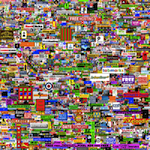
 Digging in the Cache is a series where we go back in time to look at fun tidbits of Internet and computer history. Up this week: The Million Dollar Homepage. We’d all like to earn $1 million on our website, wouldn’t we? Well, Alex Tew did just that. With the world’s ugliest website (yah, that’s the website on the left), which had nothing but ads. How’d he do it?
The Concept
The homepage of The Million Dollar Website has a million pixels, arranged in a 1000 x 1000 pixel grid. Images (with links) on the homepage were sold for $1 per pixel in 10 x 10 blocks ($100 minimum). Purchasers of the blocks provided tiny images to be displayed, along with a link where the image would go if clicked. The goal of the website was to sell all of the available pixels, thus generating $1 million. The website was guaranteed to be available for 5 years from it’s start in 2005.
Yup. That’s really all there is to it.
Why & How?
At the time of it’s creation in 2005, Alex was a student who was trying to raise money for his university education. He came up with the idea and spent the money to setup the site and pay for hosting. While the original ads were purchased by friends, the site quickly spread by word of mouth and was eventually picked up by sites like the BBC, The Register and Digg, which sent it’s traffic soaring. The final 1000 pixels were put up for auction on ebay and the site generated $1,037,100 in it’s final tally.
The site was largely successful due the novelty of the idea. There is no content on the site and no reason to visit it other than to see a site which generated $1 million by selling pixels.
Impact
There have been others that have tried to generate revenue from similar efforts, but have not been very successful, since there is little consumer or business value from such a site (to advertisers or visitors). Unfortunately, at the time, the site was pointed at to prove that sites could have lots of advertising on them and still be successful (which is a moot argument since the site has no other content or value). Apparently the business model still has some value (or having a site that’s a novelity perhaps), since Andrew has since applied it to a site called One Million People (which also takes advertising revenue) where you can buy space for your Facebook picture.
What are your thoughts on The One Million Dollar Homepage?
(Source: Wikipedia)